Webtoon Script Format, With a Real Example
How to lay out a webtoon script: one moment per panel, what we see first, then numbered lines. A real page script beside its art, plus a template to copy.
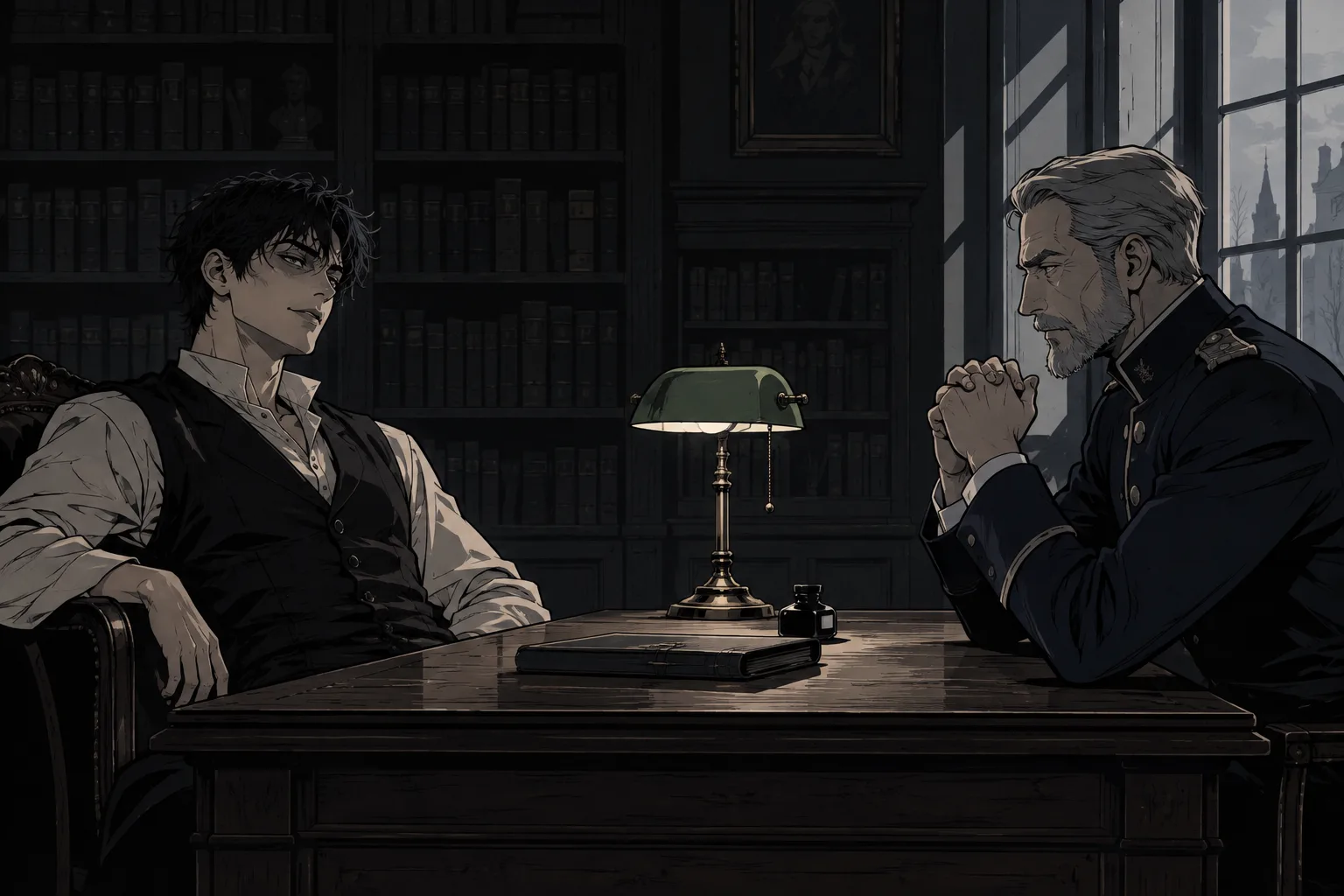
A webtoon script is a list of single moments, one per panel. For each panel you write what we see first, in a sentence or two, then every line of text in it, numbered in the order it will be read. Here is a real page script beside the page it became, so you can see what each line does.
The webtoon script format at a glance
This is page 7 from Chapter 1 of The Body Was Already Used, a comic about a man who wakes up in a fallen noble's body and starts running the plan he knows from novels. It was made on FicPal, which writes a script for every page before drawing it and shows it to you in the editor. Here is page 7's, retyped in the usual format, beside the finished page.
PAGE SEVEN (two panels)
Panel 1
Wide. The household library in grey morning light. Tall dark shelves of ledgers and account books, and a big desk buried in open ledgers and loose papers. ALDRIC, the steward, stands at the desk reading a single sheet.
No lines.
Panel 2
Medium, over Joon-Ho's shoulder. ALDRIC sits across the desk with his hands clasped on the papers, and his face gives nothing away. JOON-HO, in the near chair, touches his fingertips together and smiles a little.
- 1
JOON-HO: Aldric. I intend to restore the Renatus name.
- 2
ALDRIC: Shall I prepare a schedule of creditors, my lord.
- 3
JOON-HO (THOUGHT): Not a question. Not a reaction. This one is harder.
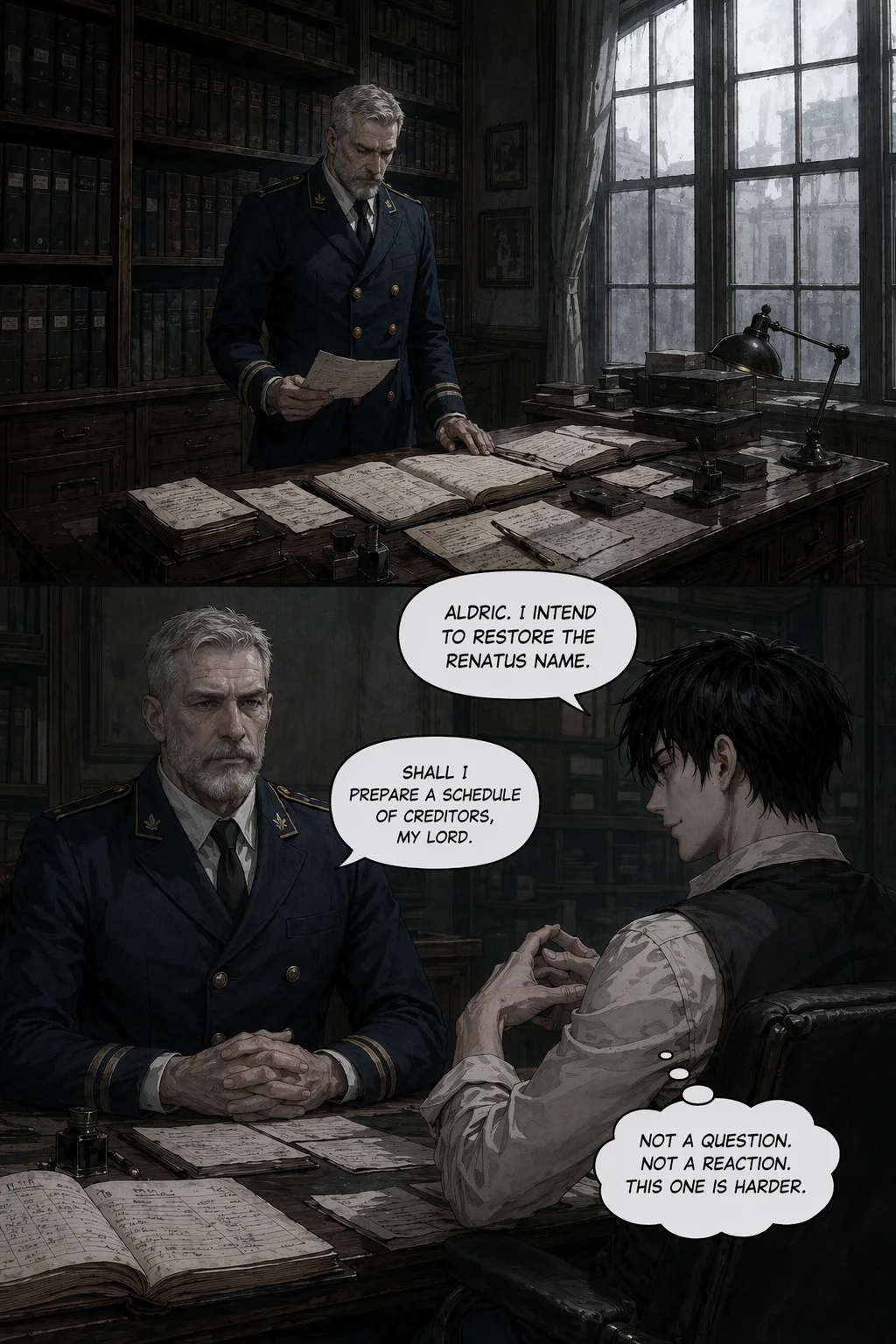
The PAGE heading tells the artist how many panels to fit before they read any further. Each panel heading starts a new moment. The description comes next, in the present tense. Under it go the numbered lines: speech, thoughts, captions and sound effects, each with the speaker in capitals.
Comic scripts have no official standard, and publishers differ on the details, but keep the line numbers. Letterer Nate Piekos asks for them in his comic script basics: they let an editor mark where each balloon goes, and “line 3” is quicker to say than “the thought in the bottom corner”.
One panel, one moment
A panel freezes one instant. An artist can draw a man at a desk, or a man sitting down, but not a man who walks in, sits down and starts talking. If your description needs “then”, or two actions that happen one after the other, you've written two panels.
Page 7 has a silent moment and a talking one. Panel 1 has no lines: it shows the room, with the steward already at work, before anyone speaks. Panel 2 is one exchange, about as much talk as a panel holds.
The Dark Horse script guide puts the comfortable limit at a comment, a response and a counter-response, in about 50 words. Panel 2 is exactly that, in 27.
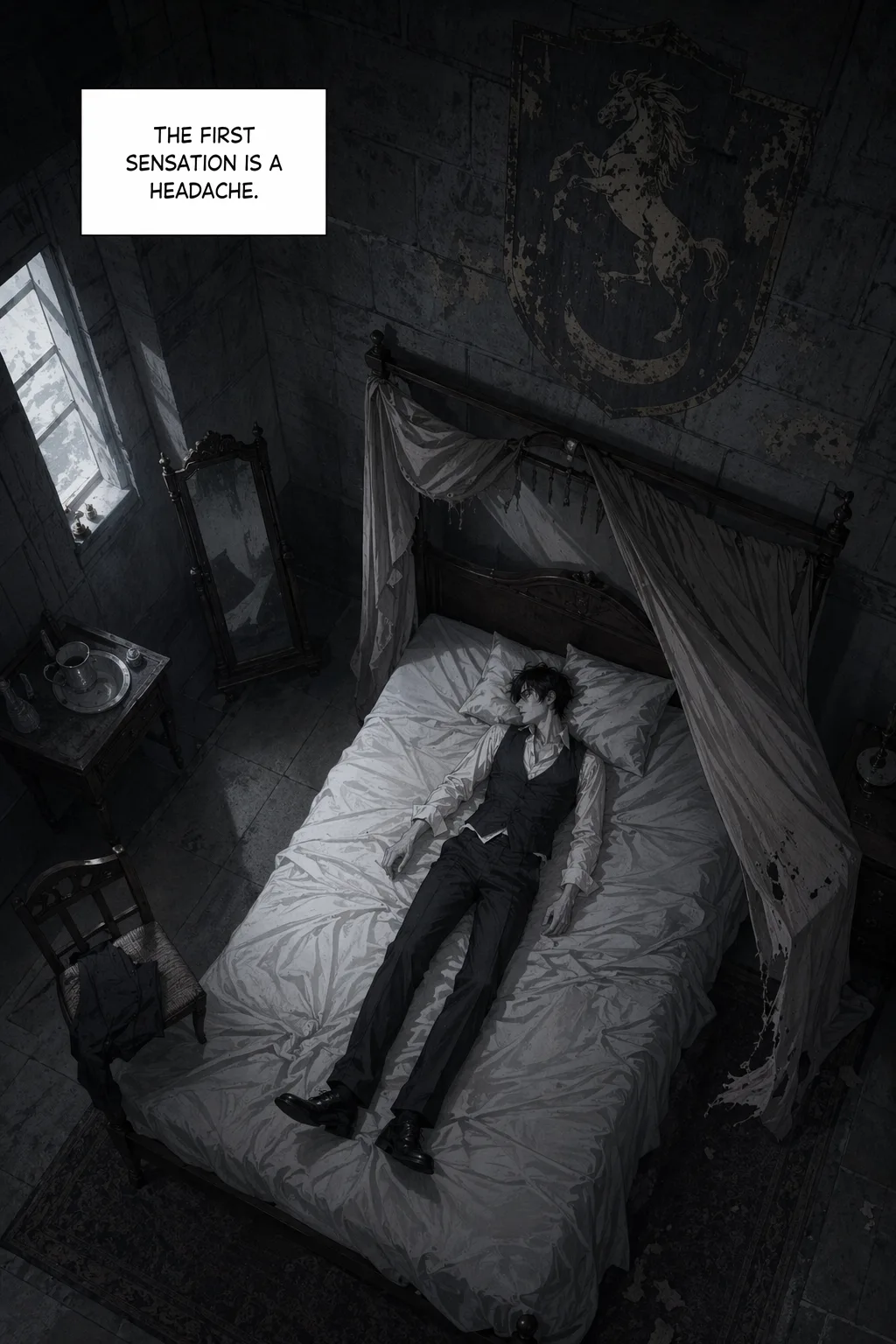
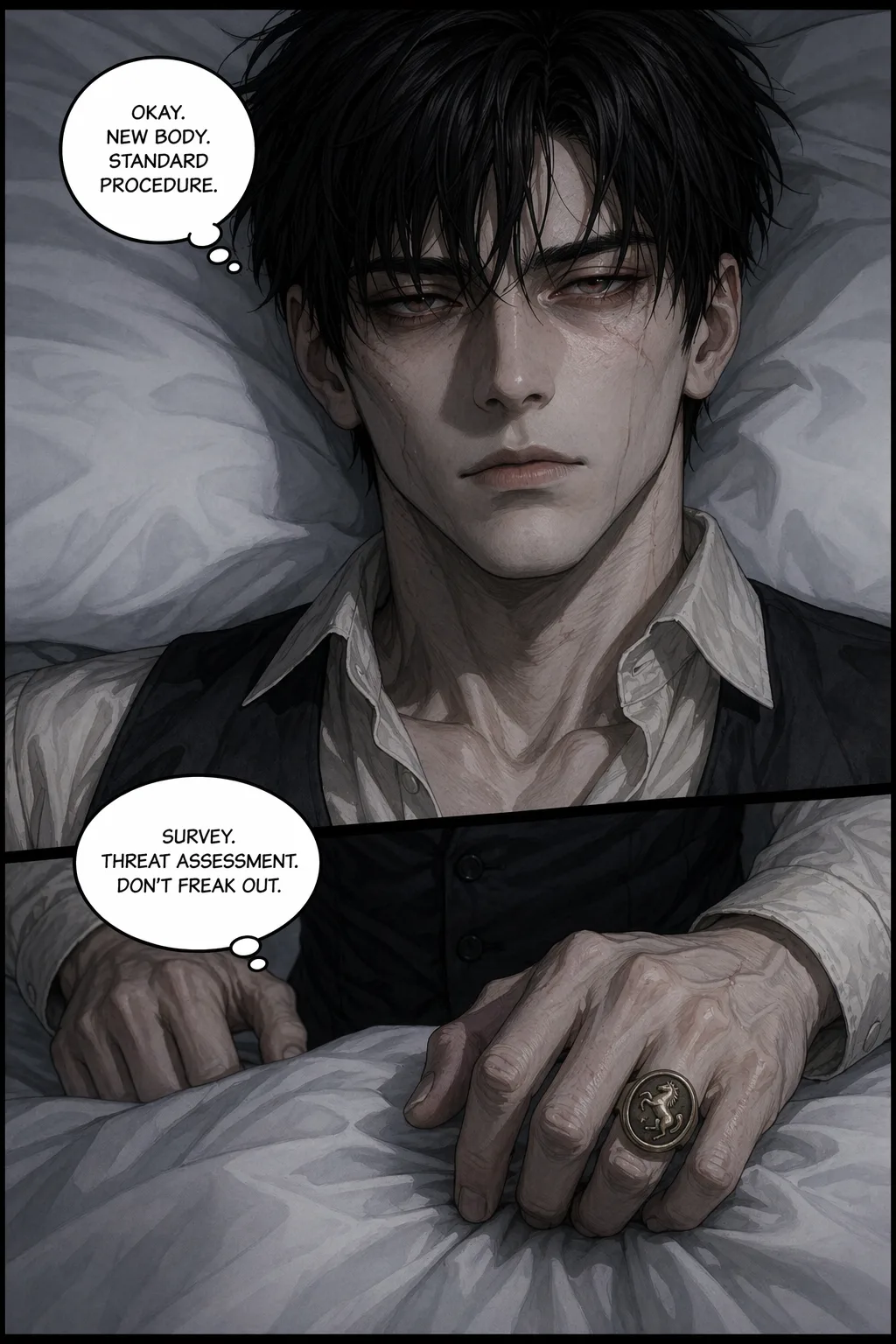
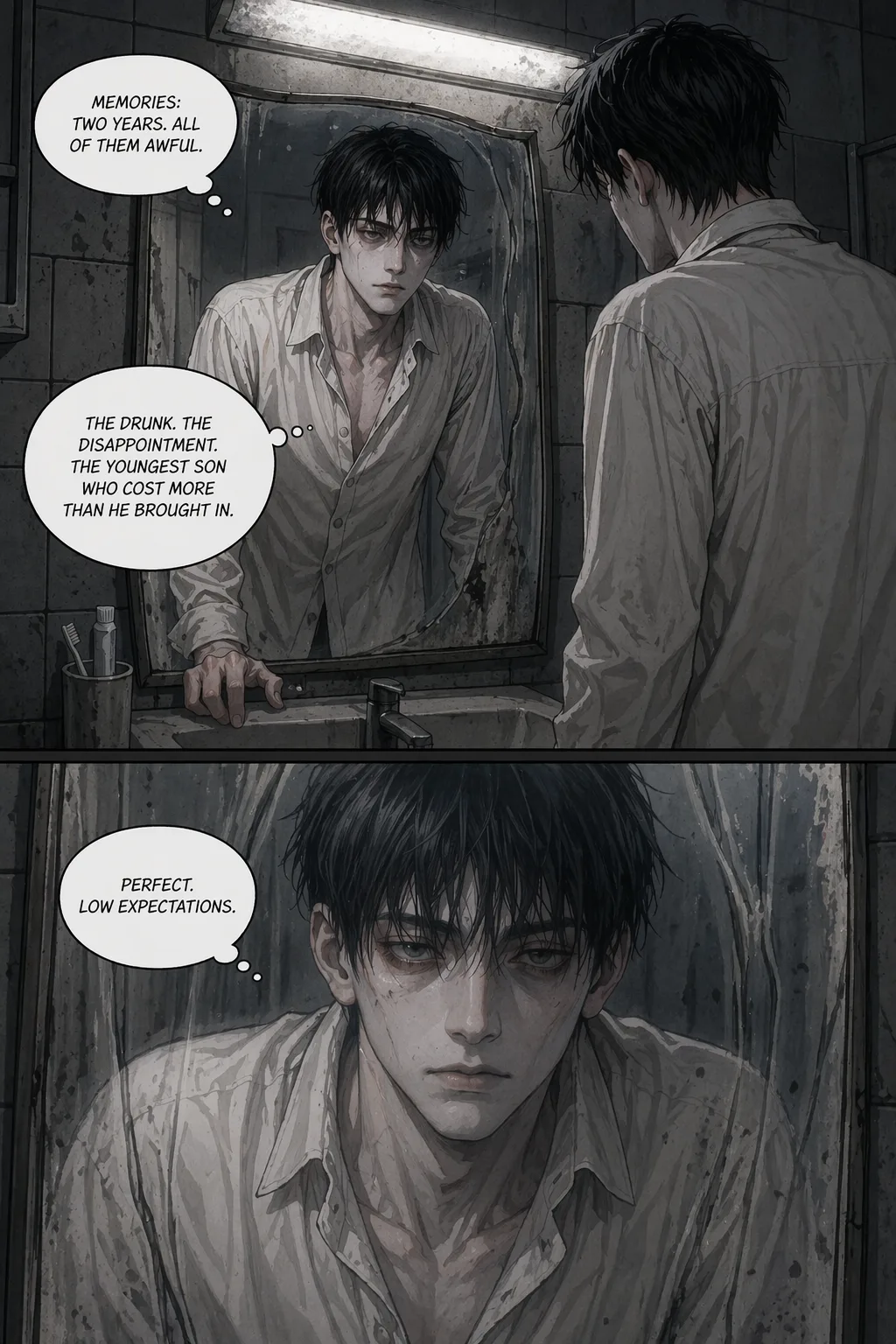
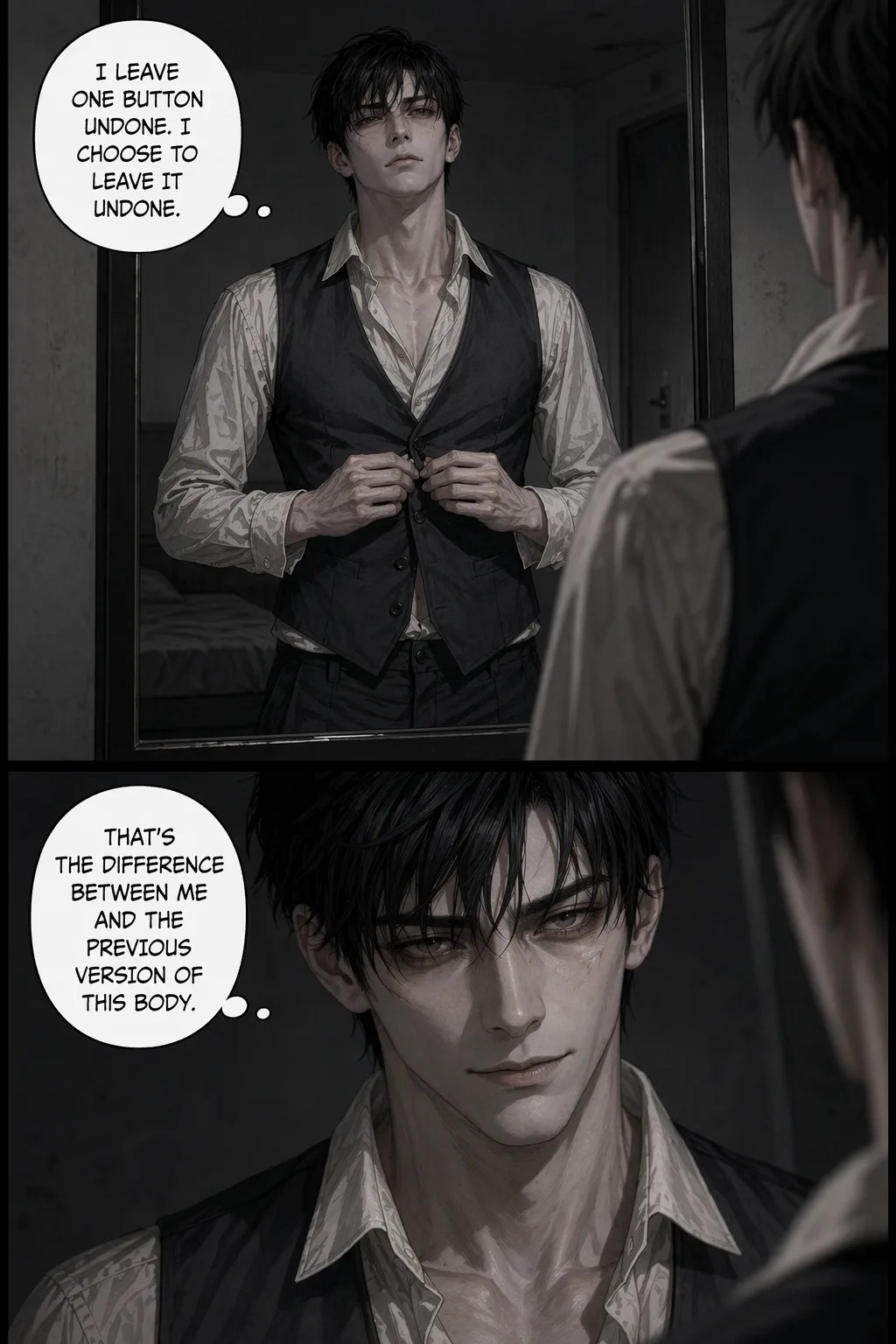
A scrolling chapter has room to give small moments a panel of their own. This one spends its first four pages and seven panels on one sentence of story: a man wakes up in a stranger's body and dresses for the part.
How many panels a whole episode needs is a separate question, covered in how many panels are in a webtoon episode.
What we see first, then the lines
Write the whole description before the first line, and don't go back to action between lines. The artist reads the description to stage the panel and leave space for the text, and the letterer works down the numbers.
Describe only what a camera could catch. “Aldric is suspicious” can't be drawn. “Aldric sits with his hands clasped and his face gives nothing away” can, and it's what panel 2 shows.
Panel 2
Medium, over Joon-Ho's shoulder. ALDRIC sits across the desk with his hands clasped on the papers, and his face gives nothing away. JOON-HO, in the near chair, touches his fingertips together and smiles a little.
- 1
JOON-HO: Aldric. I intend to restore the Renatus name.
- 2
ALDRIC: Shall I prepare a schedule of creditors, my lord.
- 3
JOON-HO (THOUGHT): Not a question. Not a reaction. This one is harder.
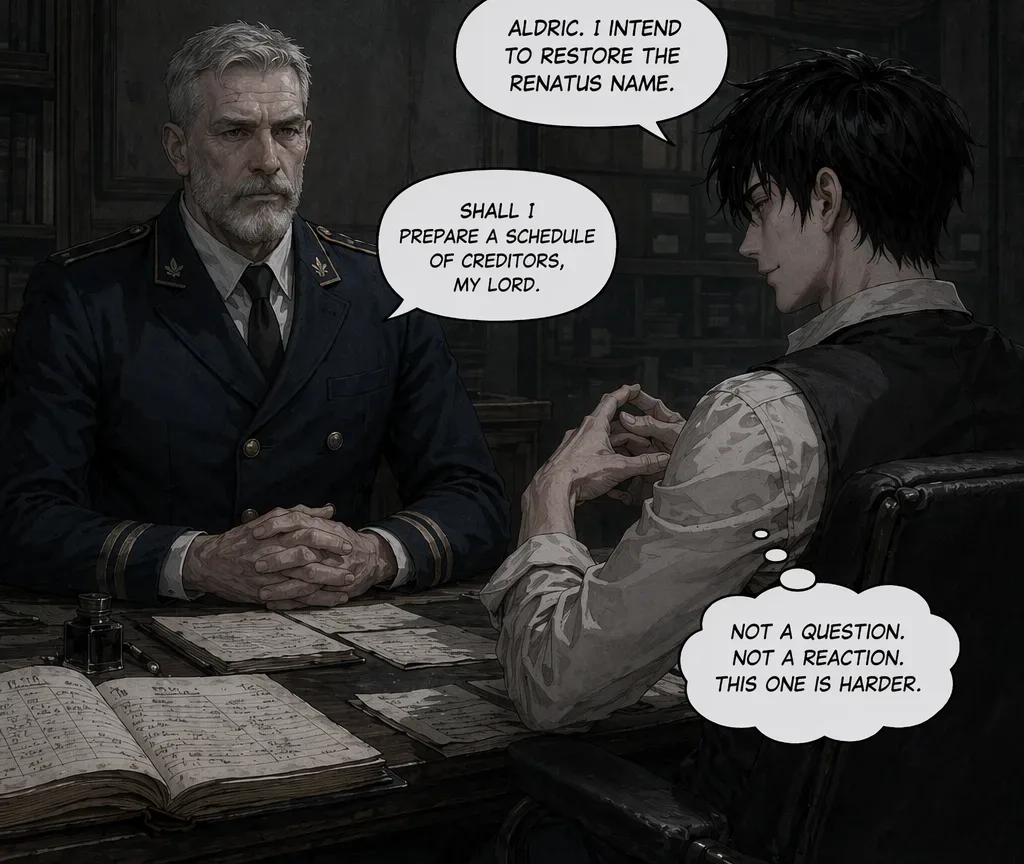
Type punctuation exactly as you want it lettered, because the letterer copies it as written. Line 2 ends in a period where a question mark should be, and line 3 is Joon-Ho noticing it. Put a question mark there and line 3 makes no sense. Cut line 3 and the reader never learns that the lead has just met someone he can't read.
List the lines in reading order. Put the speaker in capitals and add a tag when the text isn't plain speech: (THOUGHT), (OFF) for a voice outside the panel, CAP for a caption, SFX for a sound. Type the words in normal sentence case and let the letterer set the capitals. Which balloon each tag becomes, and where it goes, is in our guide to speech bubble types.
If you're adapting a novel, cut it down to what can be seen and heard before you script; turning a novel into a comic walks through it.
A webtoon script template to copy
Copy it and replace everything in brackets. It keeps PAGE headings for artists who draw in page-sized sections. If yours works on one long strip, change PAGE to SCENE and keep numbering panels through the episode.
TemplateTwo pages, five panels
[SERIES TITLE], Episode [number]: [episode title]
Script by [your name]

PAGE ONE (three panels)

Panel 1
[Shot size: wide, medium or close.] [Where we are, the time of day, the light.] [Who is in frame, left to right, and what each one is doing at this one moment.]

1 CAP: [Place or time, only if the reader needs it.]
2 [CHARACTER]: [What they say, in normal sentence case.]

Panel 2
[One new moment. Only what a camera could see: actions, faces, objects.]

3 [CHARACTER]: [The reply.]
4 [CHARACTER] (THOUGHT): [What they think and don't say.]

Panel 3
[The moment the scene turns on.]

5 [CHARACTER] (OFF): [A voice from outside the panel.]
6 SFX: [The sound, spelled the way it should be lettered.]

PAGE TWO (two panels)

Panel 1
[Description.]

1 [CHARACTER]: [Line numbers start again at 1 on each page.]

Panel 2
[Description.]

No lines.
Script one page before the rest of the episode. Sketch its panels as rough boxes, or hand it to your artist, and check that every box holds one moment and every line fits. Then write the rest.
If you'd rather have the script and the drawing done for you, paste a premise into FicPal's Describe it box. The AI writes every page's script and dialogue, then draws a lettered Chapter 1. Your first comic is currently covered by the 80 free credits you get at signup; each chapter after that costs 50 purchased credits.
Questions people ask.
What should I write a webtoon script in?
Any word processor works. Comic editors and letterers usually ask for a Word file, which Google Docs can export. Leave out tabs and special formatting so each line copies cleanly into the lettering file.
Is a manga script written the same way?
Japanese manga is usually planned as a name: rough page thumbnails with the dialogue written in, which an editor checks before the final art. If you're writing for an artist, the typed format here works for manga too. Just tell them the pages read right to left.
Do I need a typed script if I draw the comic myself?
No. You can work from rough thumbnails with the lines pencilled in. Type a script when someone else joins: a letterer, an editor or a translator works faster from numbered lines than from sketches.
Can I paste my script into an AI comic maker?
You can paste up to 8,000 characters into FicPal's Describe it box, but it treats your text as a premise. The AI writes its own page plan and dialogue, so your panels and lines won't come through one for one. The editor then shows each page's script, and you can change a line for free or redraw a page from an edited script. To keep your own script exact from the start, work with an artist or draw the pages yourself.
Make one yourself
Get a scripted, drawn Chapter 1 from your premise
Paste a premise of 40 to 8,000 characters. Your lettered Chapter 1 is usually ready in about ten minutes.