How to Turn a Novel Into a Comic: What to Cut
A comic keeps only what a reader can see or hear. Here is a real Monte Cristo passage marked keep and cut, and the comic pages it became.
To turn a novel into a comic, go through it a sentence at a time and keep only what a reader could see or hear: people, places, actions, lines said out loud, sounds. Whatever the narrator explains has to move onto a face, shrink into a caption, or go. Below is a real passage from The Count of Monte Cristo marked that way, beside the comic page it became.
Keep what a reader can see or hear
A novel can tell you what a man is thinking and why the room went quiet. A comic can only show the room going quiet. So test each sentence: could a camera or a microphone catch it? If not, it needs a new home or it goes.
Then cut again for pace. Plenty of what characters say aloud is polite noise, and a panel gets crowded after a few lines, so keep the lines that change the scene. Our webtoon script format guide covers how much talk one panel can hold.
Expect to lose most of the text. In the comic below, the novel's first five chapters, about 17,000 words, became one 24-page chapter with roughly 800 words of lettering.
The arrest scene from Monte Cristo, marked keep and cut
Edmond Dantès is a young sailor in Marseilles in 1815, about to be made captain and to marry Mercédès. Two jealous rivals have denounced him as a Bonapartist agent, and in Chapter 5 the law arrives at his betrothal feast. It's the betrayal that starts one of fiction's best-known revenge stories, and the betrayed hero who comes back for revenge is still a familiar manhwa trope. Here is the moment word for word, from the public-domain 1846 English translation on Project Gutenberg.
- Draw it
- Letter it
- Put it on a face
- Cut
Cut: As no attempt was made to prevent it, Drawn: the door was opened, and a magistrate, wearing his official scarf, presented himself, followed by four soldiers and a corporal. Shown on a face: Uneasiness now yielded to the most extreme dread on the part of those present.
Cut: “May I venture to inquire the reason of this unexpected visit?” said M. Morrel, addressing the magistrate, whom he evidently knew; “there is doubtless some mistake easily explained.”
Cut: “If it be so,” replied the magistrate, “rely upon every reparation being made; meanwhile, Drawn: I am the bearer of an order of arrest, Cut: and although I most reluctantly perform the task assigned me, it must, nevertheless, be fulfilled. Lettered: Who among the persons here assembled answers to the name of Edmond Dantès?”
Drawn: Every eye was turned towards the young man who, Shown on a face: spite of the agitation he could not but feel, Drawn: advanced with dignity, Cut: and said, Shown on a face: in a firm voice:
Lettered: “I am he; what is your pleasure with me?”
The Count of Monte Cristo, Chapter 5, The Marriage Feast. Anonymous English translation, 1846.
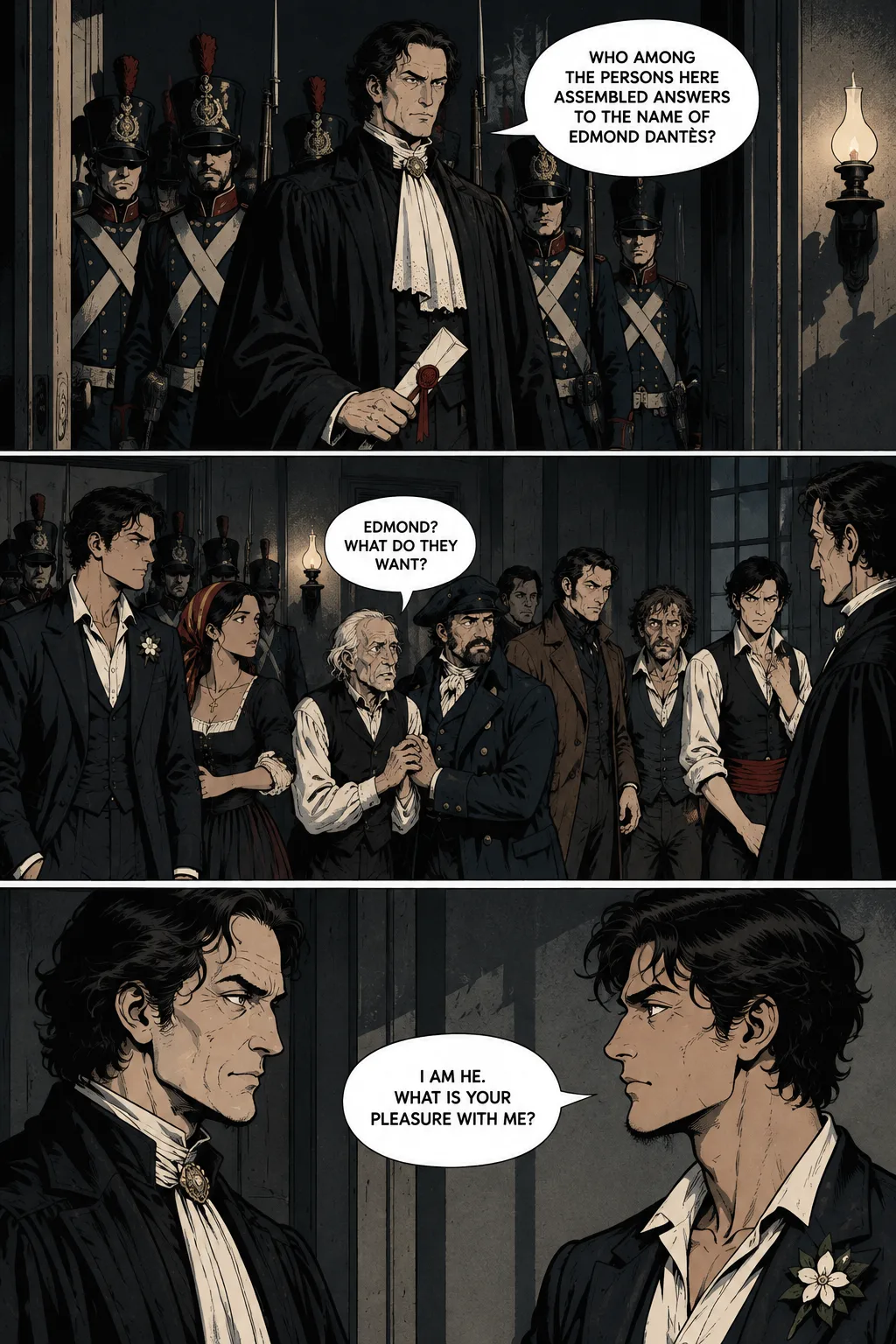
Everything marked Draw it ended up in a panel: the magistrate, the soldiers, the young man stepping forward. Even the order of arrest the magistrate mentions turns into a thing you can see, a sealed paper in his hand. The novel's “every eye” narrows to one pair of eyes in the bottom panel, the magistrate's, fixed on Edmond.
Letter it marks the only two lines that move the scene: the question and the answer. Put it on a face marks feelings. Dumas says the room's uneasiness “yielded to the most extreme dread.” The middle panel shows it instead, with the guests pulling back and Edmond's father gripping the man beside him.
The struck-through lines are what a comic can't afford. Morrel's polite question and the magistrate's apology are both spoken aloud, so they pass the first test, but they stall the scene right before it turns. Of the passage's 157 words, 22 are lettered on the page.
Inner thoughts become faces, captions or nothing
Most of what a narrator tells you can't be photographed: what someone feels, what day it is, what a man mutters to himself. Each has its own place on a comic page.
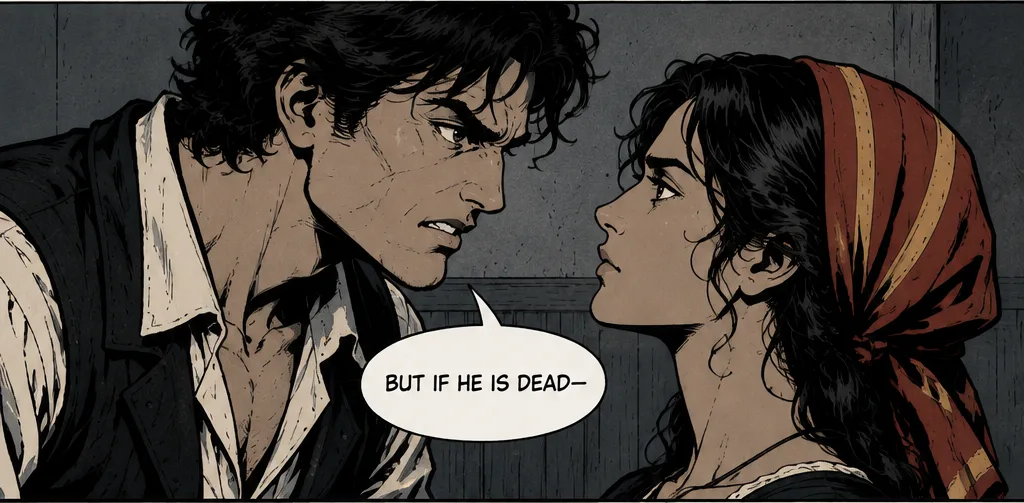
The first is a face. When Fernand presses Mercédès to marry him, Dumas says he looked at her “with an air in which vexation and uneasiness were mingled,” and that her “firm and steady gaze” controlled his look. The comic draws exactly that and never puts it into words.
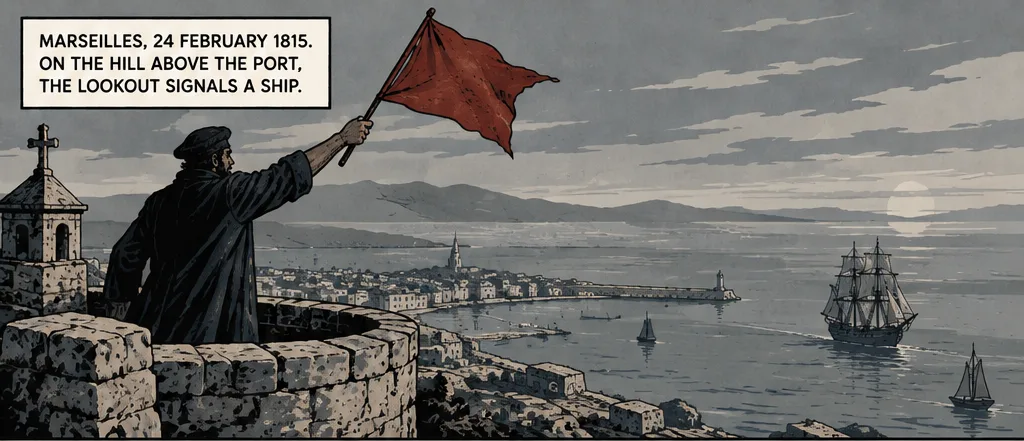
The second is a caption, for facts no picture can carry, like a date or the ports a ship sailed from. The novel's first sentence names the day, the lookout, the ship and her route. The comic draws the lookout and the ship and hands the rest to two caption boxes.
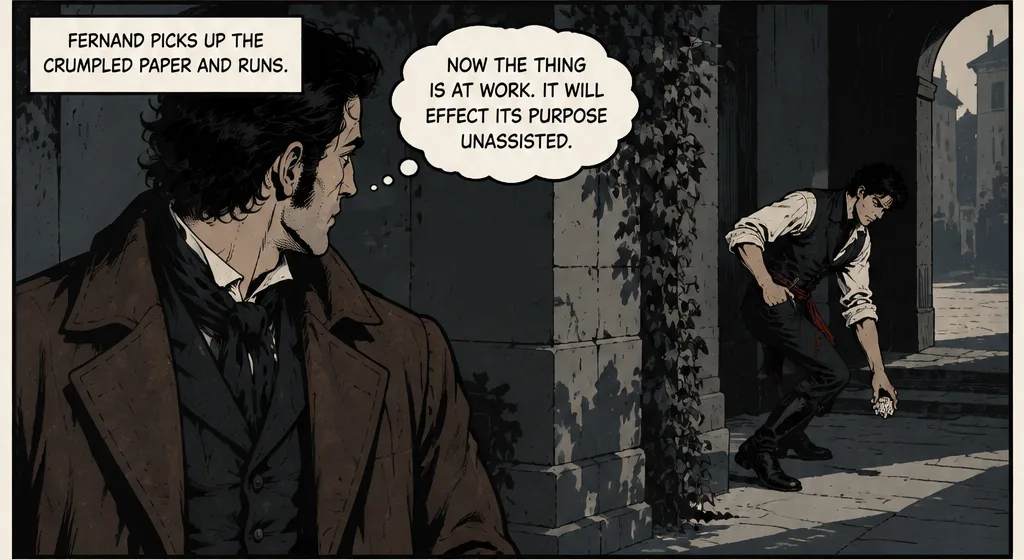
The third is a thought balloon, for when a character talks to himself. Once Fernand has run off with the letter, Danglars says “to himself” that “now the thing is at work.” The comic keeps his line and puts it in a thought.
Narration can also turn into dialogue. Dumas writes that Caderousse “looked around for Fernand, but he had disappeared.” In the last panel of page 23, Caderousse asks out loud where Fernand went, with an empty chair at the table.
The rest goes. After the arrest, Dumas gives Morrel a few lines of reflection: pleading with the magistrate, he knows, would be like addressing a petition to “some cold marble effigy.” It's a lovely sentence with no picture in it, and the comic drops it.
What FicPal made from the cut text
We pasted the cut-down opening into FicPal's Describe it box, which takes up to 8,000 characters, plus 2,000 more of names, limits and notes under More options. Ours came to about 6,100: one line of instructions, then the kept lines from the first five chapters in order. The tone notes at the end said where Chapter 1 should end.
InputThe instruction line and tone notes we used
Adapt the opening of The Count of Monte Cristo by Alexandre Dumas. The lines below are from the public-domain 1846 English translation, cut down to what a reader can see or hear. Keep the names, Marseilles in 1815, and the order of events.

[About 5,900 more characters: the kept lines from Chapters 1 to 5, in order, under five headings (The Arrival, Father and Son, The Catalans, Conspiracy, The Marriage Feast), with each cut marked [...].]

Tone notes:
A faithful period adaptation: Marseilles harbour in 1815, sailors, a Catalan fishing village, a tavern arbor, a wedding feast. No magic, no fantasy. Chapter 1 ends as Dantès is driven away under arrest and Mercédès calls after him from the balcony.
The AI doesn't draw your text line by line. It writes its own outline and dialogue from it, so the result is a free adaptation. Before drawing anything, it retold the whole chapter in under 400 words, and the 157-word passage above shrank to two sentences: “He asks for Edmond Dantès. Edmond answers.”
PlanWhat the AI wrote before drawing Chapter 1
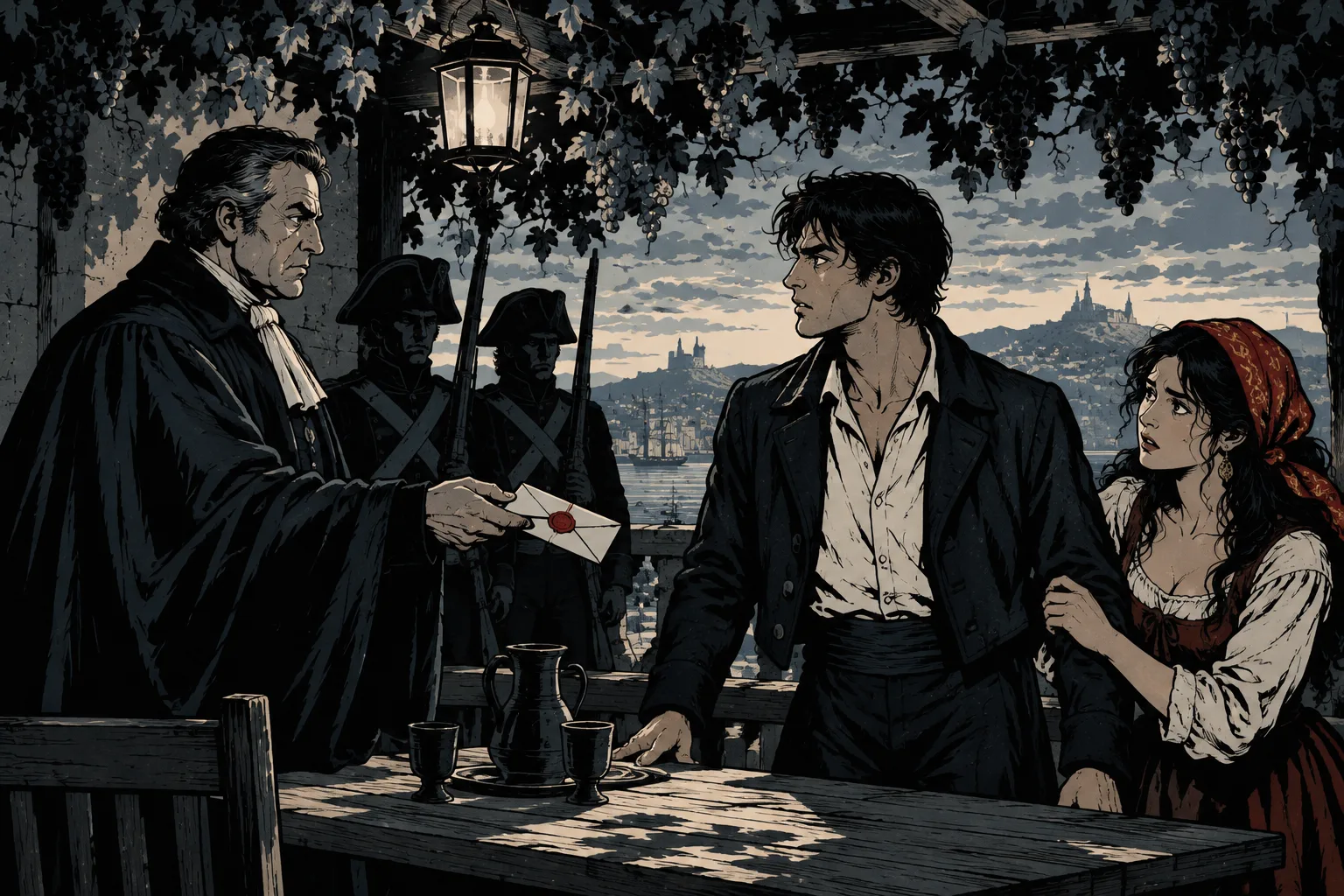
Marseilles, 24 February 1815. The lookout at Notre-Dame de la Garde signals the Pharaon home from Smyrna, Trieste, and Naples. The harbour crowd gathers as M. Morrel, the shipowner, goes out in a pilot skiff. On deck, young Edmond Dantès stands beside the pilot, black-eyed and raven-haired, and Morrel calls up to him. Edmond reports that Captain Leclere died off Civita Vecchia. Behind them, Danglars, the supercargo, watches with hate and complains that Edmond took command and wasted time at Elba. When Morrel asks about the packet, Danglars claims Leclere entrusted a letter to Edmond. Morrel nevertheless promises Edmond the captaincy. Edmond thanks him in the name of his father and of Mercédès. Danglars, jealous, begins to imagine a way to ruin him.

At home, Edmond finds his father training nasturtiums over a trellis, and tells him he is to be captain at twenty, with a hundred louis and a share in the profits. In the Catalan village, Mercédès refuses Fernand once more: she loves Edmond and will marry no one else. Edmond arrives, and they embrace. Fernand's hand moves to his knife, but Mercédès steps between them and names Fernand as her cousin and friend.

That evening in the arbor at La Réserve, Danglars sits with Fernand and a drunken Caderousse. Danglars speaks of denouncing Edmond as a Bonapartist agent because he touched at Elba. Fernand cries out that he will do it. Danglars writes the denunciation with his left hand, disguising his writing, then crumples it and throws it aside. Caderousse calls it an infamous shame but does nothing. Fernand secretly picks up the paper and rushes out. Danglars smiles and lets the trap work.

The next day is the betrothal feast at La Réserve. Edmond sits beside Mercédès; his father, Morrel, Danglars, Caderousse, and a pale Fernand are at the table. Three blows strike the door, and a magistrate enters with four soldiers, demanding admittance in the name of the law. He asks for Edmond Dantès. Edmond answers. The magistrate arrests him. Caderousse looks around for Fernand, but Fernand has disappeared. [The plan ends with Mercédès calling after Edmond from the balcony.]
As the input asked, it kept the names: Edmond Dantès, Mercédès, Fernand, Danglars, Caderousse, Morrel, the Pharaon, La Réserve. It lifted many lines as written, like “If he is dead, I shall die too.” It also wrote new ones, such as Fernand's thought on page 12 as his hand goes to his knife: “No. Not him. Not in front of me.” What else a premise should spell out is covered in how to make a comic with AI.
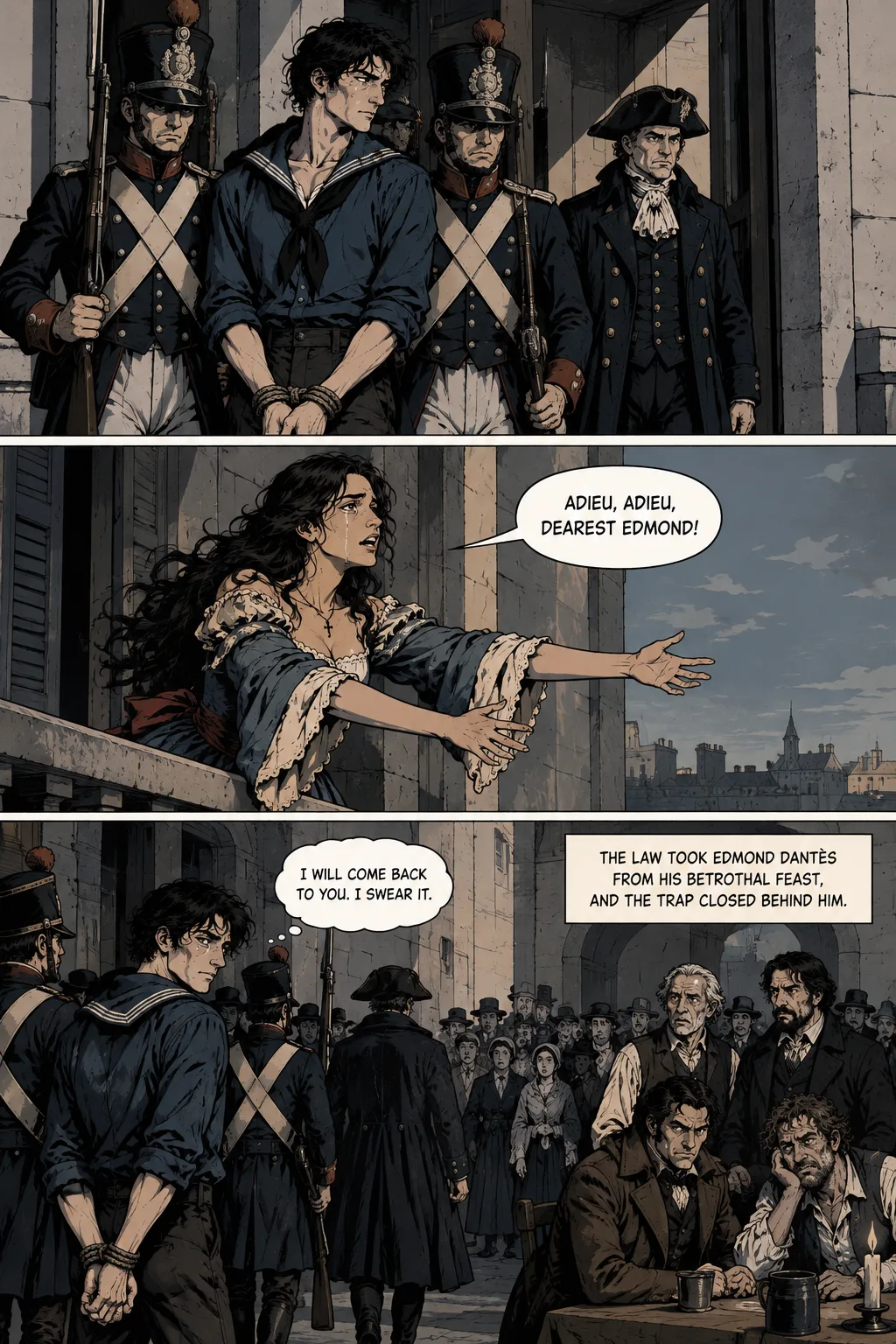
It isn't flawless: on page 23 the robed magistrate turns into an officer in a tricorn hat, and a single page couldn't be redrawn when we made it. The editor can now fix one with a sentence. The AI also picked the look itself, a dark, limited-palette Korean thriller style, because we picked none. Today you can choose one of 19 styles yourself.
Chapter 1 was ready in about 11 minutes. You can read all 24 pages of The Count of Monte Cristo: Marseilles. Its outline stopped at the arrest, which is unusual: most FicPal outlines run to several chapters, and each one after Chapter 1 currently costs 50 purchased credits to unlock. Your first comic is currently covered by the 80 free credits you get at signup.
Turning fanfic into a comic: what's allowed
The same cut works on fanfic. What changes is what you're allowed to paste.
FicPal's content policy welcomes original fan-fiction comics set in existing universes. It bars uploading scans or rips of licensed comics and reproducing substantial portions of someone else's work. So paste a fic you wrote, not pages copied from the original books or comics.
New comics on FicPal start out public, so only adapt a fic you're happy for strangers to read, or set the comic to unlisted or private.
Pasting a novel's actual text, as we did, is only safe once the book is in the public domain. In the US that currently means works published before 1931, and other countries have their own rules. A translation has its own copyright too, which is why we used the 1846 one.
Whatever you're adapting, the routine is the one this comic went through:
- Mark every sentence of a scene: draw it, letter it, put it on a face, or cut it.
- Cut the spoken lines that don't change the scene, however good they sound.
- Paste what's left in story order, and ask for the names to be kept.
- Say where Chapter 1 should end, at the end of the text or in the notes under More options.
Questions people ask.
Can I turn my own novel or story into a comic?
Yes. Run the same cut on your manuscript, then paste the result into the Describe it box. You keep ownership of your plot and characters, but the AI writes its own dialogue, FicPal's Terms make no promise of commercial rights to the art, and new comics are public until you set them to unlisted or private. If you want art you own outright, for a print edition say, hire an artist.
Which novels are easiest to adapt?
Books where things happen in rooms and people say them out loud: adventure, crime, romance and revenge stories. Novels told mostly inside one narrator's head lose the most in the cut, because their best parts are the reflection a comic has to drop.
Do comic chapters have to match the novel's chapters?
No. End each comic chapter on a turn that makes the reader want the next one, wherever that falls in the book.
Make one yourself
Paste your cut-down chapter below
Up to 8,000 characters of text plus 2,000 of notes. Your lettered Chapter 1 is usually ready in about ten minutes.